


In North Carolina, and nationwide, job market growth has stalled

Why?
Job woes are reality, especially for Black and young workers and even workers with college degrees. In North Carolina, 7,200 manufacturing jobs disappeared in 2025. Between last April and this past March, Business Insidermagazine reports, the U.S. added only 152,000 jobs, averaging fewer than 4,000 a month, compared to 77,000 a month average over the same months in 2025.
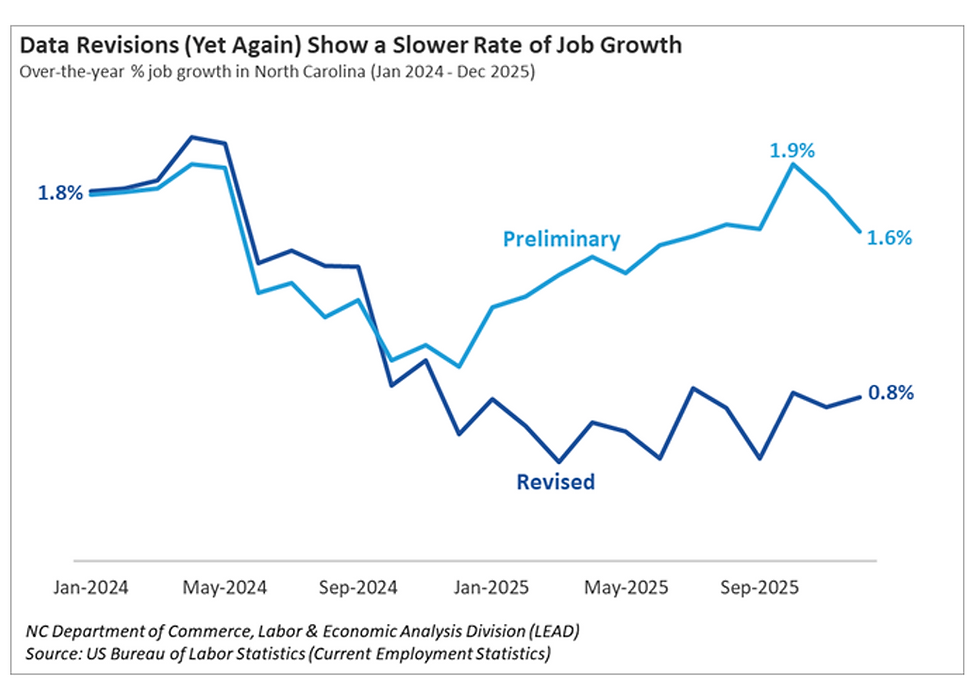
Most N.C. industry sectors and metro areas report this downward trend, the fifth consecutive year of a labor market slowdown. The U.S. Bureau of Labor Statistics annually revises labor market indicators; data revisions in recent years often show job growth has been slower than initially estimated. Why?
Possible explanations include the immigration crackdown, which reduces the number of people coming to the United States to work, artificial intelligence replacing workers, and, idiosyncratic tariff policies.
Shortfalls persist especially in the Asheville area as complete recovery from Hurricane Helene remains elusive. OK, there is that hurricane effect—a plausible reason.
Another reason, according to some economists, is the influence of erratic behavior from the administration. Uncertainty is never good for the economy. Only four months ago, in his State of the Union address the president said the economy “is roaring like never before.” The latest data on jobs, pump prices and the stock market suggests otherwise, according to Fortune magazine. And there are ongoing, multiple-state lawsuits over Trump’s tariffs.
Meanwhile, midterm elections loom.
Trump’s tariffs and the war in Iran certainly influence economic outlook, if only through uncertainty.
So. How is Trump managing the economy?
One economist who advises governments worldwide, calls his policies “an idiosyncratic hodgepodge.”
Trump claims tariffs have reduced the “U.S. trade deficit by 24% from April 2025 through February 2026 compared to the same period a year earlier, and [it has] decreased every single month on a year-over-year basis since Liberation Day.”
Politifact found that “Trump exaggerated the deficit's decline on his watch by a factor of 10.” And, Steve Ellis, president of Taxpayers for Common sense, notes, “The deficit has not been meaningfully cut, much less slashed by 25%."The cumulative 2025 trade deficit for the 15 trade partners with which the United States had its largest deficits in 2024 increased by $85.26 billion. Taxpayers for Common Sense is a Washington, D.C.-based group that tracks budget policy. The White House provided no evidence to support the statement.
Though reports say the economy added 178,000 jobs in March, and unemployment is low, at 4.3 percent, hiring is sluggish. Job seekers are pessimistic about prospects. This leaves unemployed workers dependent on unemployment benefits or severance, which may or may not be forthcoming. Uncertainty reigns.
Betty Joyce Nash reported for the Greensboro News & Record and the Hendersonville Times-News before moving to Virginia where she worked as an economics writer for the Federal Reserve Bank of Richmond. She co-edited Lock & Load: Armed Fiction, an anthology of literary short stories that probe Americans' complicated relationship to firearms. (University of New Mexico Press, 2017.)


Comments